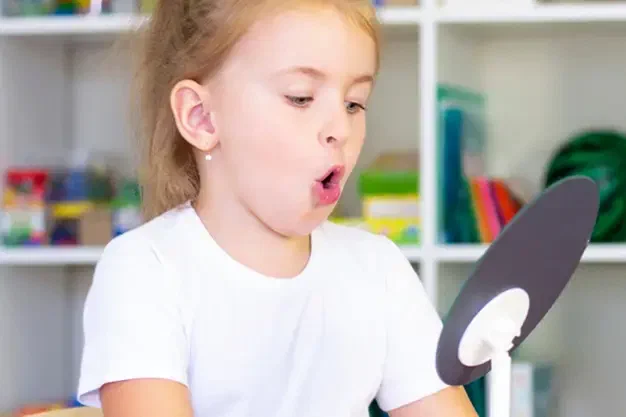
Pediatric Speech Therapy at Root Pediatrics in Bozeman
When a child has trouble being understood, finding words, putting sentences together, or navigating social conversation, the right speech therapy can change school, family, and friendship life. Pediatric speech therapy at Root Pediatrics in Bozeman is delivered by a licensed speech-language pathologist using naturalistic, play-based approaches and structured family coaching — with a particular focus on early intervention.
We see children from late talkers and toddlers with first words to school-age kids working on articulation and adolescents with social-communication or fluency challenges. Feeding, swallowing, and oral motor difficulties are also part of what our SLP treats directly — and for children with complex multi-system needs, our SLP collaborates seamlessly with the OTs and PTs at Root Pediatrics.
Conditions We Treat
- Speech sound disorders — articulation errors and phonological patterns affecting intelligibility.
- Childhood apraxia of speech (CAS) — a motor-planning disorder that calls for specialized, evidence-based approaches.
- Late talkers and expressive language delay — children with fewer words than expected for age.
- Receptive language delays — difficulty understanding language, following instructions, or attending to spoken information.
- Mixed receptive-expressive disorders — concerns in both understanding and producing language.
- Stuttering and fluency disorders — preschool stuttering, school-age fluency, and adolescent stuttering modification.
- Social communication and pragmatic language — turn-taking, topic maintenance, perspective-taking, conversational repair.
- Autism-related communication — across the verbal-language spectrum, with play-based, child-led support.
- Hearing-loss-related speech delays — coordinated with audiology.
- Feeding, swallowing, and oral motor difficulties — picky eating, chewing and swallowing trouble, and infant feeding challenges (see our Pediatric Feeding Therapy page for the fuller picture).
Signs Your Child May Benefit from a Speech Evaluation
- Not babbling by 12 months
- Fewer than 5–10 words by 18 months
- Fewer than 50 words or no two-word combinations by 24 months
- Hard to understand for unfamiliar listeners by age 3
- Frequent frustration or “I don’t know what to say” past expected age
- Stuttering with visible effort, repetitions of whole words, or avoidance behaviors
- Difficulty following directions, answering questions, or telling a story
- Social communication challenges — trouble joining play, following conversation, or reading social cues
- Diagnosed condition (autism, hearing loss, apraxia, neurological condition) needing speech support
What Therapy Looks Like at Root Pediatrics
- Comprehensive evaluation (60 minutes) — developmental and medical history, a speech and language assessment, an oral motor screen, observation in play, and a parent interview.
- Goal-setting with the family — concrete, measurable targets tied to what matters in your child’s life.
- Play-based, naturalistic sessions — child-led activities that target specific speech and language goals.
- Specialized approaches when needed — evidence-based motor-planning work for apraxia and fluency work for stuttering.
- Parent coaching at every visit — strategies you’ll use during meals, drives, baths, and play.
- Coordination with school SLPs and pediatrician — aligned goals and consistent strategies across settings.
- Re-assessment every 12 weeks with goals updated as your child progresses.
Why Naturalistic, Play-Based Therapy Works Best
Children acquire communication through meaningful interaction — not flashcards or drill worksheets. The strongest research-supported approaches embed targets into play your child wants to do, shape language through your child’s interests, and rely heavily on caregiver coaching for daily-life practice. That’s the model at Root.
Why Bozeman Families Choose Root Pediatrics for Speech Therapy
- A pediatric-focused SLP with ongoing continuing education.
- Naturalistic, play-based approach — engaging and effective.
- Feeding and swallowing support — a direct part of our SLP services, not just a referral elsewhere.
- Multi-disciplinary collaboration — OT, PT, and executive function support under one roof for complex cases.
- Family coaching at every visit — therapy gains carry over to real life.
- Specialized approaches — apraxia, fluency, and social communication.
- Montana Medicaid welcome alongside major commercial plans.
Take the First Step
Earlier intervention is consistently associated with stronger outcomes — but meaningful gains are possible at every age, even adolescence. Request an evaluation today — most families are seen within the same week.
Core Techniques We Use
Articulation Therapy
Modeling, cuing, tactile and visual feedback to teach correct speech sound production.
Language Intervention
Naturalistic, play-based work on vocabulary, grammar, comprehension, and narrative.
Feeding & Oral Motor Therapy
Support for chewing, swallowing, and oral motor coordination — feeding is part of what our SLP treats directly, alongside our OTs.
Pragmatic & Social Communication
Turn-taking, topic maintenance, perspective-taking, and reading social cues.
Apraxia Treatment
Specialized motor-planning approaches for childhood apraxia of speech.
Early Intervention for Late Talkers
Play-based support in the earliest years — building first words and early language, with parents coached as the main communication partners.
Fluency Therapy
Stuttering modification and fluency-shaping approaches matched to your child's age and presentation.
Who Benefits from This Service?
Why Choose Root Therapy and Wellness?
Pediatric-Focused SLP
A licensed speech-language pathologist focused on children and early intervention, with ongoing continuing education.
Naturalistic Play-Based Approach
Children learn communication best through play and meaningful interaction — not drill or worksheets.
Feeding Is Part of What We Do
Our SLP treats feeding, swallowing, and oral motor difficulties directly — it's a core part of speech-language pathology, not a separate discipline.
Multi-Disciplinary Collaboration
Our SLP works alongside OTs and PTs for children with complex developmental needs (gross motor, executive function, complex feeding cases).
Family Coaching at Every Visit
Parents leave each session with specific strategies to support communication during meals, bath time, drives, and play.
Kezia has lowered my pain level tremendously. I have chronic pain, but always feel better when I leave her office. I highly recommend her fabulous team!— W.H. Google review · June 2025
Frequently Asked Questions
When should my child start speech therapy?
What's the difference between articulation and language therapy?
How is clinic-based speech therapy different from school-based therapy?
How often will my child need speech therapy?
Can you help children with autism communicate?
What is early intervention in speech therapy?
Do you treat feeding and swallowing difficulties?
What can I do at home to help my child's communication?
Does insurance cover pediatric speech therapy in Montana?
Do I need a referral for pediatric speech therapy in Montana?
Conditions We Treat with This Service
Last updated