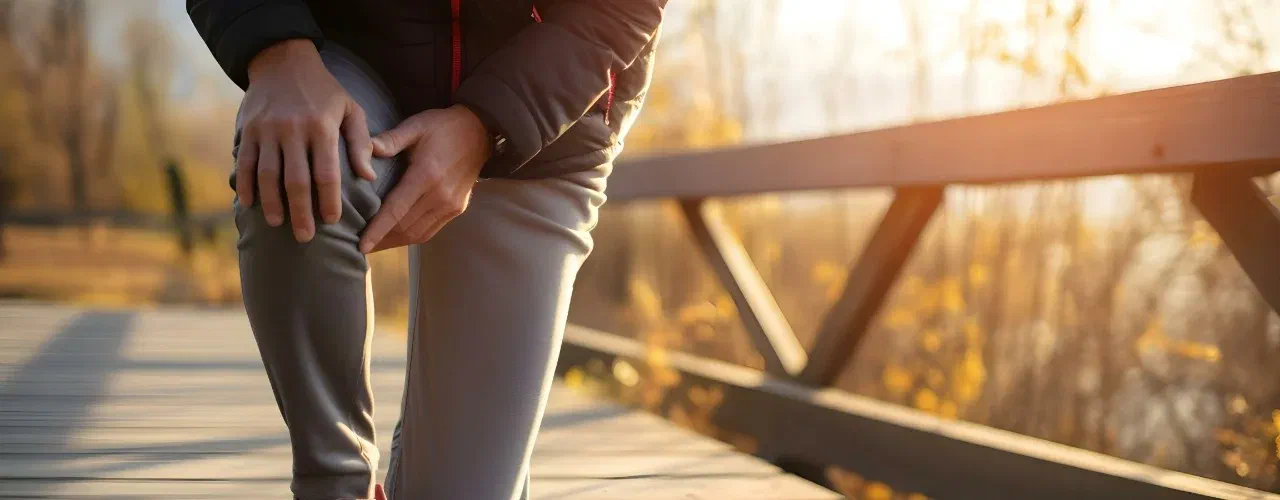
What Our Patients Experience

↓ Pain

Many patients start to feel real relief within the first several weeks of care

↑ Mobility

Restored flexibility, strength, and ease in daily activities

↓ Meds

Less reliance on pain medication as therapy progresses

↑ Function

Return to work, activity, and the things you love

A Knee Injury Doesn't Have to Slow You Down for Long

Whether you need surgery or not, good rehab is the key to getting back stronger and safer — with a plan built around your goals.

Knee pain and a feeling of instability Swelling after the injury Trouble with stairs, squatting, or pivoting A popping sensation at the time of injury

How Knee Injuries Happen

When symptoms linger long after an injury should have healed, deeper dysfunctions keep discomfort signals flowing.

Non-Contact Pivoting

Sudden slowing, cutting, or landing is the most common way the ACL is injured.

Direct Contact

A blow to the outside of the knee often injures the MCL.

Twisting Under Load

Meniscus tears happen when the knee twists while bearing weight.

Muscle Weakness

Weak quadriceps and hip muscles raise the risk of injury.

ACL, MCL, and meniscus injuries are knee ligament and cartilage injuries that cause pain, swelling, and instability — common in cutting, pivoting, and sudden changes of direction. They range from mild sprains to complete tears, and the rehab plan (with or without surgery) is matched to the injury, your goals, and your activity level.

Getting Your Knee Back After an ACL, MCL, or Meniscus Injury

A torn ACL, a sprained MCL, or a meniscus tear can happen in a single moment — a hard cut on the court, a twisting fall at Bridger Bowl, an awkward step off the trail in Hyalite. What you do next matters as much as the injury itself. Good rehabilitation is what decides whether your knee feels steady and strong again, or keeps giving out months later.

At Root Therapy and Wellness in Bozeman, we treat the whole knee, not just the sore spot. We look at how your hip, thigh, and core work together to control the joint, then build a plan that rebuilds strength, steadiness, and confidence — whether or not you have surgery.

Do You Need Surgery?

Not every knee injury does. Many MCL sprains and some meniscus tears heal well with hands-on care and the right exercises. A fully torn ACL is more likely to need reconstruction if you want to return to cutting and pivoting — but plenty of people do well without surgery once the knee is strong and stable. The right path depends on your injury, your goals, and how the knee holds up. We’ll walk you through your options and coordinate closely with your surgeon when an operation is part of the plan.

Why a Knee Stays Weak or Unstable

After a knee injury, the muscles that protect the joint switch off fast — the quadriceps especially — and swelling makes it worse. If rehab stops too soon, that weakness lingers, and the knee keeps feeling loose or buckling. We rebuild strength and control one step at a time, so the joint is supported for the long run, not just until the pain quiets down.

Start Protecting Your Knee Now

The sooner you begin, the smoother recovery tends to be — and if surgery is ahead, getting strong beforehand (“prehab”) leads to a better result. Call to schedule your evaluation, and let’s get your knee moving again.

Effective Treatment for Knee Injuries in Bozeman

We use a hands-on, step-by-step approach to calm pain, restore movement, and protect the joint:

  1. Manual Therapy & Joint Mobilization

    Hands-on techniques that improve movement and ease joint stiffness.

  2. Targeted Strengthening

    Building strength to correct imbalances and steady the knee, plus retraining how you move.

  3. Injury Prevention & Long-Term Joint Protection

    Warm-ups, strengthening, and mobility work to cut future strain and keep the knee healthy.

This approach eases pain at the source, lowers the chance of re-injury, and keeps you moving with confidence.

Our Treatment Approach

How Root Is Different

Not all therapy is created equal. Here's why our patients get better results with ACL / MCL / Meniscus.

Conventional PTRoot's Approach Root Therapy
Session ModelShared between an aide and the therapist; 15–20 min of direct PT timeA full 1-on-1 session with your therapist — no aides or technicians
ApproachSymptom-focused exercises aimed at the painful spotRoot-cause treatment — structural, movement-based, and hands-on
TechniquesStandard exercise protocols and modalities (ultrasound, e-stim)Manual therapy, strengthening, and education
AssessmentInitial eval, then occasional reassessmentOngoing assessment and adjustment every session
FocusEasing pain at the symptom levelLasting results — treating the whole system, not just the symptom

Hands-On Every Visit

Manual therapy is part of every session — not just the first visit. We assess, treat, and progress in real time.

Root Cause Focus

We find and treat the underlying problem driving your pain — not just where it hurts.

Whole-Person Approach

We look at movement patterns and lifestyle factors for lasting improvement.

5.0 out of 5
Everyone is great! I much prefer Roots to the typical physical therapy in a big open room. All of the folks I have worked with have been great!
— N.L. Google review · December 2025
5.0 out of 5
Knowledgeable PT's and very helpful in planning a program to get my balance problems resolved. I definitely recommend them.
— G.H. Google review · April 2026
5.0 out of 5
The staff is amazing and so kind. It's a great experience every time I go in. They're also very knowledgeable and do a great job explaining.
— S.W. Google review · April 2026

Frequently Asked Questions

Do all ACL tears need surgery?
Not always. Some people — especially those with lower activity demands — do well with a well-rehabbed knee and no surgery. Active people who want to get back to cutting and pivoting usually do better with reconstruction. The right choice depends on your knee, your goals, and any meniscus or cartilage involvement.
How long is recovery after ACL reconstruction?
Full recovery usually takes 9–12 months. We use milestone goals at each phase — not just calendar time — to guide your return to activity.
Can a meniscus tear heal without surgery?
Often, yes — especially tears in the outer, better-supplied part of the meniscus. The location, size, and type of tear all matter. We’ll help you understand your options.
How do I avoid re-injury after a knee ligament tear?
Keeping your hip and quad strength up, along with balance and coordination training, greatly lowers the risk. We build prevention into your rehab from day one.
When can I get back to activity after a knee injury?
We use clear, objective checks — strength and functional testing — not just time. You progress when your body shows it’s ready.
Should I do "prehab" before ACL surgery?
Yes, if time allows. Going into surgery stronger is consistently linked to a faster, better recovery. We can start prehab soon after the injury.

Last updated

Recovering from a knee injury?

Hands-on knee rehab with clear, milestone-based goals. No referral needed for most plans.

Most insurance accepted · Serving Bozeman, Belgrade, Manhattan, Four Corners & the Gallatin Valley · Mon–Fri 8am–5pm

Prefer we reach out to you?

Leave your details and we’ll get back to you — or call us now at (406) 219-5388.

We’ll only use this to get back to you — see our privacy policy.

Call Now Text Us

Request a callback

Leave your details and we’ll get back to you.

We’ll only use this to get back to you — see our privacy policy.