What Our Patients Experience

↑ Range of Motion

A steady return of shoulder motion through skilled hands-on care

↓ Pain

Less pain across all phases, especially night pain

↑ Function

Getting back to dressing, sleeping, and reaching overhead

↓ Duration

A faster recovery than leaving it to run its natural course

Frozen Shoulder Is Slow — But Recovery Is Possible

It's painful, it's stubborn, and on its own it can take a year or more. Skilled hands-on care meaningfully speeds recovery through every phase.

Gradual loss of shoulder motion in every direction Sharp pain at the end of your reach, especially reaching behind your back Pain that's often worse at night and disrupts sleep Trouble dressing, washing your hair, or reaching a back pocket Stiffness that outlasts the pain in the later phase Aching even at rest in the early phase

Why Frozen Shoulder Develops

When symptoms linger long after an injury should have healed, deeper dysfunctions keep discomfort signals flowing.

An Inflamed, Tightened Capsule

The shoulder's capsule becomes inflamed, then gradually thickens and shortens, limiting motion.

Diabetes

Frozen shoulder is much more common in people with diabetes, and often more stubborn.

After an Injury or Surgery

A stretch of not moving the shoulder — after a rotator cuff injury, fracture, or surgery — can set off the stiffness.

No Clear Cause

Many cases appear on their own, usually in adults aged 40–60, and more often in women.

Frozen shoulder (adhesive capsulitis) is stiffness and pain from an inflamed, tightened shoulder capsule. It moves through three phases — a painful "freezing" phase, a stiff "frozen" phase, and a gradual "thawing" phase — and can last well over a year on its own. Skilled rehab shortens and eases the course.

Skilled Care for Frozen Shoulder — Through Every Phase — in Bozeman

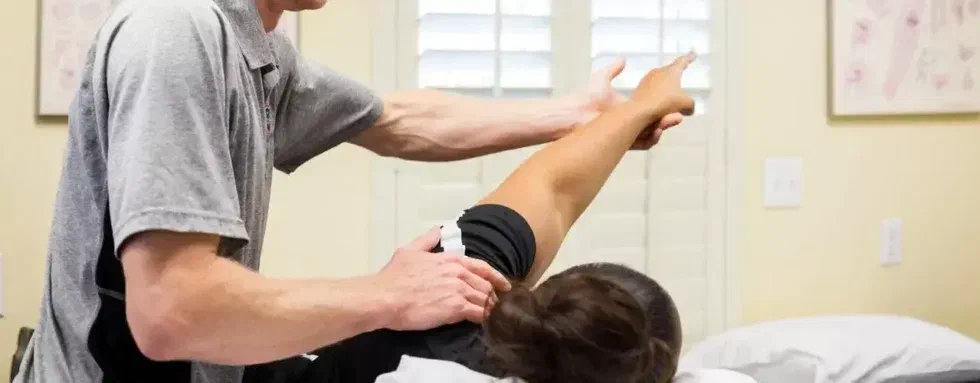
Frozen shoulder is one of the more frustrating shoulder problems: painful, slow, and sometimes lasting a year or more on its own. The good news is that skilled physical therapy genuinely changes how it goes. Gentle, hands-on mobilization is the strongest-proven treatment, and we do it every visit — matched to your phase and what your shoulder can tolerate that day.

At Root Therapy and Wellness in Bozeman, frozen shoulder care happens in full 1-on-1 sessions, with hands-on treatment, gentle stretching, and the pacing and sleep strategies that get you through the painful early phase.

The Three Phases

Freezing (roughly 1–9 months): pain leads, especially at night, and motion slowly drops. Care focuses on easing pain, gentle movement, and sleep positioning.

Frozen (roughly 4–12 months): the pain often eases but the stiffness sets in. Care shifts to firmer mobilization and stretching to win back motion.

Thawing (up to about 24 months): motion gradually returns. Care focuses on rebuilding strength and getting you back to full use.

We match technique and intensity to your phase — the approach for the painful early phase isn’t right for the stiff later one, and the other way around.

What to Expect at Your First Visit

  1. Comprehensive evaluation (60 minutes) — your history, which phase you’re in, motion measurements, and a check for contributing factors like diabetes or a recent injury or surgery.
  2. Diagnosis and plan — a phase-specific approach with a realistic timeline.
  3. Hands-on treatment that same visit — gentle graded mobilization and soft-tissue work.
  4. Home program — daily mobility work and sleep positioning.
  5. Re-assessment every few visits, tracking your motion over time.

Take the First Step

Starting earlier generally means a faster, less painful recovery. Request an appointment today — most patients are seen within the same week.

Our Treatment Approach

  • Gentle Graded Mobilization — Hands-on shoulder mobilization matched to your phase and tolerance — the strongest-proven treatment for frozen shoulder.
  • Sustained Stretching — Holding gentle end-of-range stretches to lengthen the tightened capsule.
  • Soft-Tissue Work — Easing the muscle guarding that builds up around the shoulder.
  • Shoulder-Blade Mobility — Restoring shoulder-blade motion so the arm keeps moving while the joint recovers.
  • Pacing & Sleep Strategies — Activity and sleep-position tips to manage night pain through the worst phase.

How Root Is Different

Not all therapy is created equal. Here's why our patients get better results with Frozen Shoulder.

Conventional PTRoot's Approach Root Therapy
Session ModelBrief direct PT; aide-led stretchesA full 1-on-1 session with your therapist
ApproachGeneric stretches with no phase-appropriate progressionPhase-specific — different techniques for the painful, stiff, and thawing phases
TechniquesStandard exercises onlySkilled mobilization, gentle stretching, and pacing
AssessmentInitial eval onlyOngoing reassessment with motion benchmarks
FocusGeneral range of motionFaster recovery and less pain through all phases

Hands-On Every Visit

Skilled hands-on mobilization is the strongest-proven treatment for frozen shoulder — and we do it every session.

Phase-Specific Care

The painful "freezing" phase and the stiff "frozen" phase call for different techniques. We adjust accordingly.

Diabetes Coordination

Frozen shoulder is more common and more stubborn with diabetes — we coordinate with your medical team.

5.0 out of 5
The staff is amazing and so kind. It's a great experience every time I go in. They're also very knowledgeable and do a great job explaining.
— S.W. Google review · April 2026
5.0 out of 5
I saw my primary care doctor for back and leg pain. She recommended I get physical therapy. I contacted Root Therapy and wellness. I was able to get an appointment in the next week. They did an evaluation and discussed a treatment plan. My providers were Kristi, PT, and Lindsey, PTA, they both were very respectful, explained every step and made sure I understood. Thanks to them I'm now pain free. I recommend them without reservation.
— T.M. Google review · May 2026
5.0 out of 5
I have had an incredible experience at Roots. The woman at the front desk is so helpful and kind. My PT Kristi had helped me rehab my knee and hip so that I can take my dog on hikes again and climb my stairs without pain. I feel heard and seen at my appointments. My time in the office is incredibly helpful. My home exercises are simple but very effective so I actually do them. I also work with Lindsey who is a PT assistant and she has helped my knee with cupping and other manual work. Lindsey has helped me build my strength, balance, and I’m stating to work on endurance/ cardio. I feel like I’m in safe and thoughtful hands at Roots- highly recommend!!!
— A.W. Google review · June 2026

Frequently Asked Questions

How long does frozen shoulder last?
Left alone, it typically runs 12–24 months across three phases (freezing, frozen, thawing). With skilled physical therapy — hands-on mobilization and gentle graded stretching — recovery is meaningfully faster and a lot less painful.
Can frozen shoulder be cured?
Yes — most cases fully resolve, though it can take time. Skilled rehab restores motion and function in nearly everyone. A small number with severe, stuck stiffness may benefit from a procedure to free up the joint if conservative care stalls.
Why does it hurt so much at night?
Lying on the affected shoulder presses on the inflamed capsule, and with nothing else to distract you, the pain stands out more. We teach sleep positions and pain-management tips that help most people get through the worst phase.
Can I avoid the "frozen" phase if I start early?
Possibly. Gentle hands-on care in the painful early phase may shorten and soften the stiff phase that follows. The earlier you start, the better — though care partway through still meaningfully changes how it goes.
Should I get a steroid injection?
For some people, especially in the painful early phase, a steroid injection from your physician can calm the inflammation and open a window for active rehab. Paired with PT, it can speed things up. We’ll talk through the pros and cons at your evaluation.
Does diabetes make frozen shoulder worse?
It can. Frozen shoulder with diabetes is more common, often more stubborn, and may take longer to resolve. We coordinate with your primary care provider as part of your care.
Will I lose strength for good?
No. Once the capsule loosens and the pain settles, strength comes back with gradual loading. We rebuild shoulder and shoulder-blade strength in the later phases of rehab.
Can both shoulders get frozen?
Yes — some people develop it on the other side at some point. We teach you the early signs so we can start care quickly if it begins on the other shoulder.
Do I need a referral for frozen shoulder PT in Montana?
No — Montana is a direct-access state, so you can schedule PT without a referral. Some insurance plans require one for coverage; we verify at your benefits check.

Last updated

Stuck with a stiff, painful shoulder?

Skilled, hands-on frozen shoulder care in Bozeman — gentle graded mobilization every visit to speed recovery. No referral needed for most plans in Montana.

Most insurance accepted, Medicare welcome · Serving Bozeman, Belgrade, Manhattan, Four Corners & the Gallatin Valley · Mon–Fri 8am–5pm

Prefer we reach out to you?

Leave your details and we’ll get back to you — or call us now at (406) 219-5388.

We’ll only use this to get back to you — see our privacy policy.

Call Now Text Us

Request a callback

Leave your details and we’ll get back to you.

We’ll only use this to get back to you — see our privacy policy.