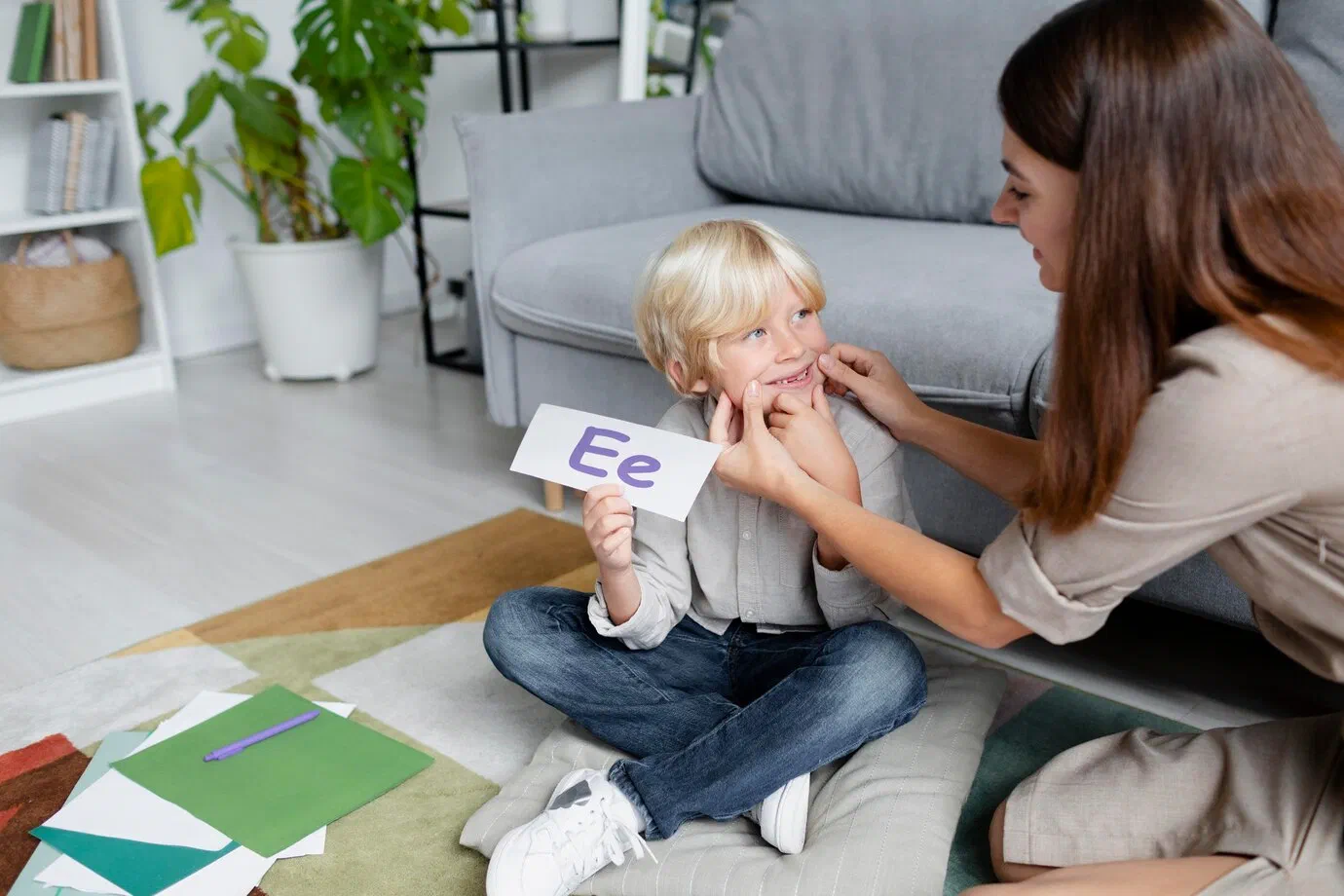
What Our Patients Experience

↑ Skills

Measurable progress on developmental and communication milestones

↑ Clarity

Easier-to-understand speech for family, peers, and unfamiliar listeners

↑ Confidence

Greater willingness to participate, take risks, and engage socially

↑ Family Calm

Less frustration and fewer communication-driven behaviors at home

Every Child Deserves to Be Heard

Communication is how children connect, learn, and grow. If something is making that harder than it should be, the answer isn't to "wait and see." Early evaluation either confirms typical development or starts intervention during the most responsive period of life.

Limited words or sentences for age (e.g., fewer than 50 words by age 2) Difficulty being understood by family or strangers Trouble following directions or answering questions Frustration, withdrawal, or behavior issues tied to communication Difficulty making eye contact, taking turns, or engaging socially Stuttering, repetitions, or unusual speech rhythm Echolalia (repeating phrases) without functional use Sensory sensitivities that interfere with social participation

What Affects Communication Development

Many factors contribute to communication challenges — understanding the specific drivers guides effective therapy.

Developmental Variation

Some children develop language on a delayed but typical trajectory; others have a true disorder requiring targeted support.

Hearing Concerns

Even mild or fluctuating hearing loss (often from chronic ear infections) significantly impacts speech and language development.

Neurodevelopmental Differences

Autism spectrum, childhood apraxia of speech (CAS), developmental language disorder, and Down syndrome each have distinctive communication profiles requiring specialized approaches.

Oral Motor & Sensory Factors

Reduced oral motor coordination or sensory differences can affect speech production and feeding-related sound development.

Language Environment

Quality and quantity of language exposure shape early development — but environment alone rarely explains a true disorder.

Pediatric communication challenges include speech sound disorders (articulation, phonology, motor speech/CAS), expressive and receptive language delays, language disorders, social communication differences (often associated with autism), and fluency disorders (stuttering). Early identification and play-based therapy produce better long-term outcomes than waiting and seeing.

Pediatric Communication Therapy in Bozeman: Play-Based, Family-Centered, Neurodiversity-Affirming

Communication challenges show up in many ways — a toddler with no words, a four-year-old who’s hard to understand, a child whose social engagement looks different from peers, a child who stutters. Each pattern needs a different therapeutic approach, and matching the right approach to the right child is what produces real progress.

Pediatric communication therapy at Root Pediatrics in Bozeman is delivered by a speech-language pathologist who works with early intervention, autism, speech-sound differences, and family-centered care. Full 1-on-1 sessions in a child-friendly environment, with parents as active partners.

Our Approach

  • Play-based and motivation-driven — children learn fastest in activities they actually want to do.
  • Child-led when possible — we follow your child’s interests to build engagement and language.
  • Neurodiversity-affirming — we support your child’s authentic communication, not a neurotypical script.
  • Family-centered — we teach parents what to do at home, because that’s where most learning happens.
  • Multi-disciplinary — collaboration with our pediatric OTs and PTs when feeding, sensory, or motor factors are involved.

What to Expect at Your First Visit

  1. Comprehensive evaluation (60 minutes) — history, parent interview, age-appropriate assessment of speech, language, social communication, and play.
  2. Findings and plan — a clear picture of where your child is, what’s affecting development, and what therapy would look like.
  3. Family discussion — your concerns, goals, and questions guide priorities.
  4. First session strategies — practical things to try at home before the next visit.
  5. Re-assessment every 3 months with goals and progress reviewed together.

Why Bozeman Families Choose Root Pediatrics

  • Speech-language pathologists with pediatric specialization.
  • Multi-disciplinary team — SLP, OT, PT under one roof when your child needs more than one.
  • Play-based therapy in a child-friendly clinic space.
  • Neurodiversity-affirming approach — we support your child as they are.
  • Direct access — no referral required in Montana.
  • Most insurance accepted.

Take the First Step

The earlier therapy starts, the more responsive a developing brain is to it. Request an appointment today — most families are seen within the same week.

Our Treatment Approach

  • Articulation & Phonology Therapy — Targeted, play-based work to teach correct production of specific speech sounds and patterns.
  • Language Intervention — Building vocabulary, sentence structure, comprehension, and narrative skills through engaging activities.
  • Childhood Apraxia of Speech (CAS) Therapy — Motor-speech approaches for children who have trouble planning and sequencing the movements for speech.
  • Social Communication Support — Turn-taking, perspective-taking, joint attention, and play skills — for autistic children and others who benefit from social-pragmatic support.
  • Early Intervention for Late Talkers — Play-based support in a child's earliest years — building first words and early language, with parents coached as the main communication partners.
  • Parent Coaching & Home Carry-Over — Strategies parents use during everyday routines — narrating, modeling, expanding, and creating communication opportunities.

How Root Is Different

Not all therapy is created equal. Here's why our patients get better results with Pediatric Communication Issues.

Conventional PTRoot's Approach Root Therapy
Session ModelGroup sessions or shared therapist attentionFull 1-on-1 session — your child's therapist is fully present
ApproachStandardized protocols based on diagnostic labelIndividualized, play-based, motivation-driven goals
SettingClinical environment with limited engagement toolsEngaging child-friendly environment with therapeutic play equipment
FamilyParent observes from waiting roomParents are active partners learning home strategies
FocusIsolated skill drillingFunctional communication for daily life, school, and play

Play-Based & Engaging

Children learn through play. Sessions are fun, motivating, and clinically purposeful — not drills.

Family Partnership

Parents are integral to therapy. We teach you what to do at home so progress carries over.

Multi-Disciplinary

Speech-language pathology, occupational therapy, and physical therapy collaborate seamlessly when needed.

5.0 out of 5
The staff are friendly, easy to talk to and helpful. Kezia explained to me how scar tissue from surgery can keep the muscles in a tight position. Even with physical therapy the muscles will revert back to the tight position even while keeping up with physical therapy exercises. This is new to me and I can feel everything loosening up. I'm excited to see how much this can help.
— S.G. Google review · March 2024
5.0 out of 5
Root Pediatrics has been wonderful! Their approach to PT for my 9 year old was amazing. Hannah listened well, really connected with my child, and made the PT fun. Anytime we had struggles with an exercise, she’d switch up the approach making it continually doable for my child to stay engaged and making progress. Their facility is excellent, made specifically for kids! Highly recommend!!
— J.G. Google review · April 2024
5.0 out of 5
Root therapy helps identify full body health and concerns after multiple surgeries. Very helpful with continued therapy after surgeons therapy focused on one part of the body. I enjoy the education and therapist and staff. Thank you
— R.W. Google review · September 2025

Frequently Asked Questions

When should I be concerned about my child's speech or language?
Common warning signs include no babbling by 12 months, no words by 18 months, fewer than 50 words by age 2, no two-word combinations by 2.5 years, speech that’s hard for family to understand at age 3, or persistent frustration around communication. If you’re wondering, an evaluation is worth it — early identification produces better outcomes than waiting.
Is my child just a "late talker"?
Some late talkers do catch up on their own, but research shows there’s no reliable way to predict who will and who won’t without an evaluation. About half of late talkers continue to have language difficulties through school. Early evaluation either confirms typical development or starts intervention during the most responsive period — there’s no downside to checking.
How long does speech therapy take?
It varies widely by goal and child. Some articulation issues resolve in a few months; complex motor speech or language disorders often benefit from longer-term support. We set clear, measurable goals and reassess regularly so families always know where things stand and what’s working.
What's the difference between a speech delay and a language disorder?
A speech delay involves developing on a slower-but-typical trajectory; a disorder involves atypical development that’s unlikely to resolve without intervention. Speech refers specifically to sound production; language refers to comprehension and expression of meaning. A child can have one, the other, or both.
My child is autistic. Is your therapy neurodiversity-affirming?
Yes. We focus on functional communication that supports your child’s actual goals — not on making autistic kids appear “less autistic.” We use play-based, child-led, motivation-driven approaches. Our team takes an affirming approach that prioritizes your child’s authentic communication and well-being.
What can I do at home to help my child's communication?
A lot — and we teach you specifically. Narrate activities (“you’re putting the block in the box”), model and expand language (“ball” → “big red ball”), create communication opportunities (pause and wait), read together daily, and reduce screen time during interactions. Small consistent habits in everyday routines outperform any “speech program.”
Can children outgrow stuttering?
Many preschoolers who stutter recover naturally, often without intervention. But early therapy meaningfully improves outcomes for children whose stuttering is likely to persist. Indicators that suggest evaluation include stuttering more than 6 months, family history, tension or struggle behaviors, and the child’s awareness or frustration. We assess all of these.
Do I need a referral for pediatric speech therapy in Montana?
No — Montana is a direct-access state for speech-language pathology and physical therapy. You can schedule an evaluation directly. Some insurance plans require a physician referral for reimbursement; we verify at your benefits check.
Is speech therapy covered by insurance?
For medically necessary speech and language services, typically yes — including speech-sound disorders, language disorders, and feeding-related communication needs. We verify your specific benefits before starting.

Last updated

Concerned about your child's communication?

Play-based, family-centered speech and communication therapy in Bozeman — neurodiversity-affirming and developmentally informed. No referral needed for most plans.

Most insurance accepted · Serving Bozeman, Belgrade, Manhattan, Four Corners & the Gallatin Valley · Mon–Fri 8am–5pm

Prefer we reach out to you?

Leave your details and we’ll get back to you — or call us now at (406) 219-5388.

We’ll only use this to get back to you — see our privacy policy.

Call Now Text Us

Request a callback

Leave your details and we’ll get back to you.

We’ll only use this to get back to you — see our privacy policy.